Posts

Megalopolis

Image
The good thing about Coppola is that he is insane enough to do anything for the film he wants to make. The bad thing about Coppola is that he is insane enough to do anything for the film he wants to make. I expected weirdness with some kind of entertaining value, given the type of reception that the film was getting as incoherent or incompetent. What I didn't expect was Coppola pontificating what at best seems like nonsense, and at worst seems reprehensible. It is clear that this is the same Coppola that nowadays believes that films like "Barbie" and "Oppenheimer" are a victory for cinema, the resistance. One that argues in his film about how demagogues are going to lead to the suppression of art by manipulating easily swayable masses through populism - a perspective that seems reasonable at first but easily shows itself to be cynical and incredibly pessimistic - yet whose response is more demagogy to sell the population a utopia that almost seems made by an art...

La Chimera

Image
It is intriguing how Rohrwacher portrays grave sacking as a means to escape from society. "Not a real job", as the old woman's daughters imply. Yet these diggers exist in a parallel system: if the modern world can't fulfill their own dreams, one might as well look for it into the remnants of the past to pick up anything from those glory days. These sackers enjoy life to its fullest, regardless of circumstances. Rohrwacher puts the perspective of a character who has lost his beloved one in order to approach this analogy through a more precise lens: His entire reason to partake into grave digging, explicitly rejecting the possibility of a normal life within society, is to feel closer to his love, as he remains in contact with death and the afterlife, implied by his supernatural perception. A goddess statue shows up in his life, bringing him thoughts of his love, yet it is only seen by others in the business as a means to earn money, and despairs when the head is severed...

Super Mario Bros. after 35 years

Image
The importance of the original Super Mario Bros. can't be understated: It doesn't have to do with being a genre pioneer, since games like Jump Bug , Pitfall or Pac-Land already included the jump mechanic, and the Mario franchise already had two games behind its back: Donkey Kong and Mario Bros . It isn't about being the sidescrolling game either, since Pac-Land 's and Jump Bug 's also scrolled their screens alongside the player, and a few days after the original Super Mario we had Makaimura on the arcades, which also included the jump mechanic alongside a screen that followed the player. What differentiates Super Mario Bros. from its predecessors is the creation of a world surrounding a mechanic, especifically the jump. Shigeru Miyamoto's focus as an author is the direct perception of the interactive premise for the player's immersion, and for that purpose there is particular care to the tangible effect of the environments. In simpler terms, that you ...

2022

The best new game releases of 2022 were, to me: He Fucked the Girl Out of Me (Taylor McCue, 2022) Into Ruins (Eric Billingsley, 2022) Yars: Recharged (Liudas Ubarevičius, 2022) Automaton Lung (Luke Vincent, 2022) Citizen Sleeper (Gareth Damian Martin, 2022) Know by Heart (Ice-Pick Lodge, 2022) Betrayal at Club Low (Cosmo D, 2022) Stranger of Paradise: Final Fantasy Origins (Daisuke Inoue, 2022) The best games I played in 2022 for the first time from any year were: Libble Rabble (Toru Iwatani, 1983) In the Psychic City (Hot-B, 1984) Otocky (Toshio Iwai, 1987) Golden Axe Warrior (Okaru, 1991) Heartbeat Memorial (Yoshiaki Tanaka, 1994) Darkstalkers: The Dark Warriors (Junichi Ohno, 1994) Palette (Nishida Yoshitaka, 1998) King of Dragon Pass (David Dunham, 1999) King's Field IV (Rintaro Yamada & Satoru Yanagi, 2001) One Piece Mansion (Hideaki Itsuno, 2001) Nepheshel (Studio Til , 2002) Radio Zonde (Inudon Empire, 2002) Histoire (tk, 2004) Blue Wish Resurrection (x.x. Game Room, 200...

Gothic wa Mahou Otome

Image
  Microtransactions, archetypal anime girls and an overload of monetary systems are enough alarm signs that the game should be nothing more than a product to shamelessly steal the money from the average otaku. Though since a game is not what it seems to be, but rather what it actually happens to be, a small peek at the mobile game "Gothic Wa Mahou Otome" immediately reveals its quality as an action game, where the tactile control in combination with shooting game mechanics gives birth to one of the greatest exemplars of the aesthetic capability of movement in the genre. The key of its success is in the scoring system. To obtain points, naturally a player has to hit the enemies in a stage. However, numerous variables are added that let the player increase their score. Firstly, the avatar is surrounded by a visible ring for the player, which extends its radius if they keep shooting down enemies. If the target is within this circle, the power of the shot is increased, and with t...

Sayonara Wild Hearts

Image
  The game presents itself as a story of a broken heart, with a path to self-realization and self-love, but immediately turns itself into psychedelics as soon as it gives the player the control. It decides to become a rhythm game, except there's no real sense of tempo because the visual cues are treated more as quick-time events, as environmental obstacles in the story, than the player having to immerse themself in the music, like Tetsuya Mizuguchi's "Rez", or having the challenge feel in flow with the story at hand, like Keiichi Yano's works such as "Gitaroo Man" and "Osu! Tatakae! Ouendan!". It is a fast-paced chase sequence, except that the presence of checkpoints at every corner and an unlimited amount of attempts reduces the weight and intensity of the tracks, as if the game couldn't stand the player losing, unlike high velocity games such as Toshihiro Nagoshi's "F-Zero GX". The psychedelic stylization with rapid camera ...

He Fucked the Girl Out of Me

Image
  An autobiographical story of a transgender woman and her traumatic experiences with sex work.  Personal and intense in its prose, abstract in its presentation.  Defamiliarization and impersonation as representation of the coping mechanism. The game portrays the victim as not herself but other abstract being, a shapeless ghost, as a representation of the mind distancing itself from trauma. A  melancholic, surreal sea of consciousness brings life to fuzzy, drowned memories because it is so difficult to face trauma that repressing it is the instinctive reaction to get as distant as possible from those events. And a fitting pixel-art aesthetic - not just a stylistic choice born from lack of resources but the representation of the raw feelings of an innocent mind. One of the best games of the year so far.

Favorite queer media

Image
In this post I compile many of my favorite LGBT media, stuff that has been impactful to me, so that others perhaps get to know works that may interest them. I've also probably forgotten a few works, I will update whenever I remember or get to know something new. This is also open to suggestions - I'm also trying to broaden my own horizons since it is new territory for me as well. Books: - Den lille havfrue ("The Little Mermaid", Hans Christian Andersen, 1837) - Carmilla (Sheridan Le Fanu, 1871) - The Picture of Dorian Gray (Oscar Wilde, 1890) - Der Tod in Venedig ("Death in Venice", Thomas Mann, 1911) - No se lo digas a nadie ("Don't Tell Anyone", Jaime Bayly, 1994) - Wicked: The Life and Times of the Wicked Witch of the West (Gregory Maguire, 1995) Films: - Ang Tatay Kong Nanay ("My Father, My Mother", Lino Brocka, 1978) - In einem Jahr mit 13 Monden ("In a Year of 13 Moons", Rainer Werner Fassbinder, 1978) - Senjō no Merī ...

Revolutionary Girl Utena - Podcast (+ addendum about Penguindrum)

Image
Here I did a podcast on the anime Shoujo Kakumei Utena (Revolutionary Girl Utena, Kunihiko Ikuhara, 1997) alongside the American critic and writer Tevis Thompson, in commemoration of the show's 25th anniversary. There was another question asked after the podcast was made, this time by @BeetBeatBit from Twitter, which I felt worth responding as an addendum, since it also includes further thoughts on the director. Spoiler alert on the endings of Penguindrum , Yurikuma and Utena : Q: "What do you think of Mawaru   Penguindrum (Kunihiko Ikuhara, 2011)?" I like Penguindrum , but I feel that I felt it backwards as you did because so many episodes dedicated to the stalker girl in the first half are in fact my least favorite aspect of the show, or at least made me wonder why we spend so much time with this activity that I don't feel adds that much - even when it is revealed why she behaves the way she does, I remain unconvinced. We already understood that she is a messed up...

Robotron 2084 - Twin-stick apocalypse

Image
There is something strangely beautiful about the end of the world in art and the reaction that it draws from its characters, particularly the feelings that it gets from the people facing the inevitable demise, because it is then that you see them at their rawest. Robotron 2084 fits that category as an abstract portrayal of the collapse of civilization by the hands of machines, and to that purpose it sets the player as a survivor in the middle of the catastrophe, surrounded by robots chasing down the remnant humans. You can opt to save them, but the main challenge is to get past the waves of machines. The aim of the developers is that the player feels panic in an apocalyptic scenario, and to that purpose there are two sticks, one for movement and the other one to shoot in a direction, as the survivor's defense mechanism. The repercussion this has on the player is that there's a need to coordinate betwen two forms of reaction: To dodge and to shoot, and these two draw your atten...

Adventure of Link - A "post-RPG"

Image
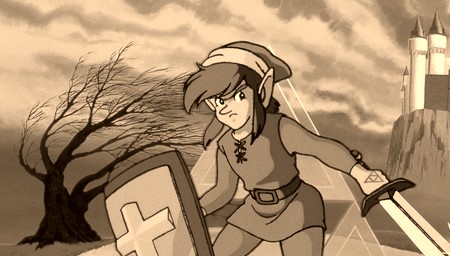
In Adventure of Link , the protagonist (Link) is already an adult, and this has certain implications in the context of the genre, filled with heroic adventures of teenagers that leave their home to fight evil and grow up during the journey. With the protagonist already having grown up and the victory against the enemy having already been reached before the events of the game, what comes after?  Adventure of Link focuses itself in adulthood instead, and its subversion comes from being a "post-RPG", a story that would come after what would happen in other RPGs, similarly to (and in certain ways a successor of) Quest of the Avatar . What this game does to accentuate this effect is the perspective shift, where the field of vision moves away from the avatar in a top-down view, blurring itself with less details, whereas the emergent events move closer from a lateral angle. This navegation system allows encounters with visible enemies on the map, trespassing caverns or discovering ...

Pac-Man - The pleasure of the maze

Image
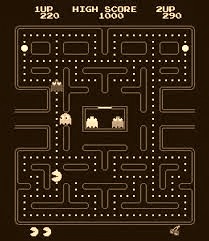
When we think about Pac-Man , one of its indelible images involves the eponymous character running away from some colorful ghosts and later him being the one that chases them after getting a Power Pellet in order to eliminate them. Because of this, Pac-Man is usually cited as the first game with power-ups. However, the ghosts have a shorter duration of vulnerability after each level, and once you reach the twenty-first screen, those Power Pellets have no impact on them, and instead ghosts are faster, which represents how little actually mattered to director Toru Iwatani to entrance the player with the satisfaction of overcoming enemies they were previously weak to. Pac-Man is a maze game where the player has to obtain all pellets and avoid ghosts that pursue the player to get to the next screen. Before its release, mazes in videogames were more closely associated with role-playing games such as Oubliette and Beneath Apple Manor , two great games of their generation that broadened th...

Genealogy of the Holy War

Image
Fire Emblem is a dramatization of warfare and conflict, where the graveness of the conflict is amplified by the permanent death, forcing the player to deal with loss, and the movement in grid in long maps with emphasis on terrain to enhance the sense of scale. These elements inevitably polarize audiences by not conforming to modern console videogame design, but the result of inducing a mental commitment with the maps is an involving quality of Fire Emblem . What the Fire Emblem creator Shouzo Kaga then decides for the fourth game, even with the risk of polarizing players even further, is to expand the size of the maps and to construct them analogically to the world so that the progress through the continent is directly perceivable by the player in order to magnify the dramatic scale of the conflict. The anticipation to the battle alongside the sense of distance while the days in war pass by. This decision in its planning is part of what makes Genealogy of the Holy War a dedicated ap...

weeb stuff I've enjoyed through the years

Image
(last update: 14/04/2023) Anime (series): Lupin III (Masaaki Osumi, Hayao Miyazaki, Isao Takahata, 1971-1972) Heidi, Girl of the Alps (Isao Takahata, 1974) 3000 Leagues in Search of Mother (Isao Takahata, 1976) Candy Candy (Hiroshi Shidara, Tetsuo Imazawa, 1976-1979) Rose of Versailles (Tadao Nagahama, Osamu Dezaki, 1979-1980) Galactic Drifter Vifam (Takeyuki Kanda, 1983-1984) Armored Trooper VOTOMS (Ryosuke Takahashi, 1983-1984) Giant Gorg (Yoshikazu Yasuhiko, 1984) Panzer World Galient (Ryosuke Takahashi, 1984-1985) Fist of the North Star (Toyoo Ashida, 1984-1987) Blue Comet SPT Layzner (Ryosuke Takahashi, 1985-1986) Touch (Gisaburo Sugii, Hiroko Tokita, Tsuneo Maeda, 1985-1987) Maison Ikkoku (Kazuo Yamazaki, Takashi Anno, Naoyuki Yoshinaga, 1986-1988) Armor Hunter Mellowlink (Takeyuki Kanda, 1988) Gunbuster (Hideaki Anno, 1988-1989) Patlabor: The Early Days (Mamoru Oshii, 1988-1989) Mobile Suit Gundam 0080: War in the Pocket (Fumihiko Takayama, 1989) Dear Brother (Osamu Dezaki, 1991...

Metroid Dead

Image
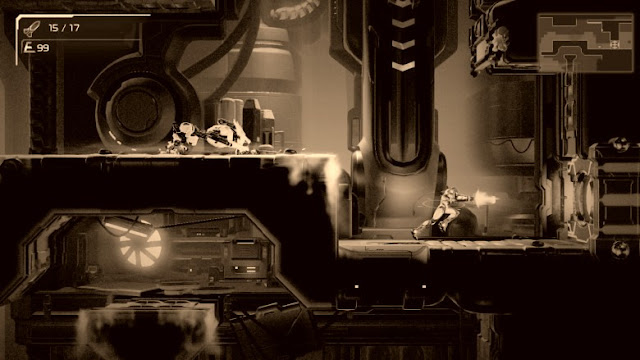
Metroid Dread follows the path of its predecessors in the Game Boy Advance: Zero Mission and Fusion. I mention these, and not Super Metroid, because of the intent of turning the movement of the protagonist, Samus, into an action figure. Up to Super Metroid there still was the purpose simulating a journey on an unknown planet through discovery of secrets and the simulation of low gravity. However, from Fusion onwards, this would disappear by reducing aerial maneuverability and softening the feeling of Samus attacking and facing enemies. The readjustment of the Melee Counter mechanic that was introduced in Samus Returns to be able to be executed during movement instead of having to stop first in order to transition smoothly between counterattacks and running manifests this understanding of what Metroid means to Mercury Steam. However, the developers show serious problems when creating an action game due to the negligent design of its obstacles. The biggest issue comes from the generic en...

Mega Man 11

Image
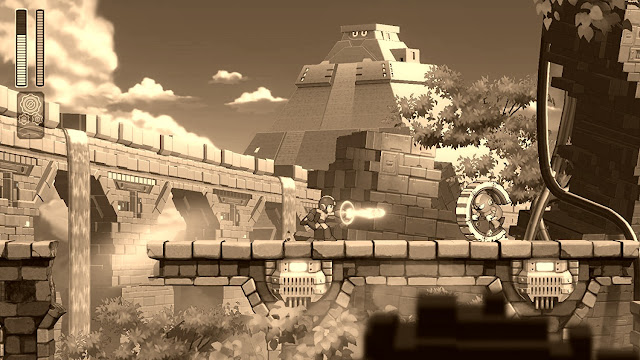
Note: I played on the hardest difficulty setting. I can see where Capcom was going with this. Play through the levels, and buy items in Dr. Light's shop with your hard earned bolts to help you prepare for each journey. There's a reason why Mega Man 11 features the longest levels in the franchise. The idea is to carefully consider what to invest on and what is more necessary for your journey, which should invite to a mental involvement with the game. It should be a huge cost to pay and you could lose it all in a game over. The problem is that Capcom somehow didn't consider how this would repercute on the player's behavior. Because enemies respawn, and there's always a chance to find bolts after destroying any enemy, it's very easy for any player to just start farming for them, and the result is that the tension of what should a player invest in disappears, since they can just buy everything at the shop after some sessions of collecting materials. Nothing in the g...

Return of Samus

Image
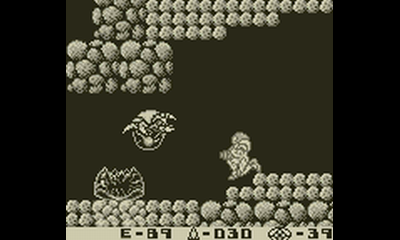
This is better than I remembered. Everything is right in its place. Disregarding the obvious inherited aspects of the original (lack of a map, black backgrounds, floating jump mechanics, only having one type of weapon at a time) that work just as well here, the changes reshape the meaning of the experience. The close camera to represent a dark cavern where watching ahead is difficult, the repeated tiles to simulate the feeling of getting lost the more one enters into labyrinthine places, and the black-and-white coloration that strengthens the limited vision. In a sense, you can interpret these elements as the developer's way to put the player in Samus's perspective, and they help as well to give thrill to the anticipation of an encounter. Even if the game is linear, it's easy to stop having track on where to go if you don't pay attention, and even if the game has some modern conventions such as save points and healing spots, it's not nearly as bad as modern works b...

Magical Drop III

Image
In this game you grab falling blocks and throw them upwards. You can grab more than one, albeit of the same colour. Matching three same-coloured blocks in a column destroys them, alongside adjacent ones of the same colour. Two design decisions contribute to the success of Data East's Magical Drop III: - The quota of destroyed blocks that the player can fulfill to win the duel, which prevents stalling. - Multiple groups of matching blocks affecting the speed of which the opponent's blocks start falling down. These two factors encourage the player to concatenate matching blocks in as few actions as possible. The key word here: Efficiency. However, blocks falling down threaten the player with a defeat, thus creating urgency to destroy blocks near the bottom. Urgency and efficiency clash with each other. It's a choice, except it's not just once, but multiple times per second, many steps ahead, while you desperately move your avatar to grab and throw blocks, and possibly mes...